A Diya Deepak is a traditional Indian oil lamp used for daily puja, aarti, festivals, temple rituals and decor. The right type depends on placement and purpose: choose a table diya for compact spaces, a hand aarti diya for movement, a Ganga Aarti lamp for ceremonial use, or wall, hanging and stand designs for fixed display.
Table of Contents
For most homes, the safest starting point is a stable brass table diya or modest stand deepak that fits the mandir shelf and is easy to clean. BharatSeLo currently groups its collection into Ganga Arti, Hand / Arti Diya, Table Diya, Wall Diya, Hanging Diya and Stand Deepak. Prices shown in this guide were checked on 22 October 2026 and can change, so confirm the live product page before ordering.
What Is a Diya Deepak
In everyday Indian usage, diya, deepak and deepa can all refer to a lamp that holds oil or ghee and a cotton wick. The words overlap, but product names often describe how the lamp is used. A compact diya rests on a surface, an aarti lamp has a handle, a hanging lamp is suspended, and a stand deepak raises the flame above the base.
The lamp carries religious and cultural meaning in many Indian communities, yet customs vary by region, family and sampradaya. It is better to follow the practice of your household or temple than to treat one internet rule as universal. Government of India tourism material on Haridwar describes Ganga Aarti as an offering of fire to the Ganga using lit lamps, while flowers and small diyas may also be floated in leaf boats.
Readers choosing specifically for Diwali can also use BharatSeLo’s guide to the best diya for Diwali to compare ceremonial and home-friendly formats.
The Six Diya Deepak Categories at a Glance
| Category | Best suited to | Live listed price examples | Practical check |
| Ganga Arti | Large ceremonial aarti | ₹1,932 to ₹6,814 | Wick count, total weight and safe handling |
| Hand / Arti Diya | Daily or festival aarti by hand | ₹97 to ₹156 among visible examples | Handle length, grip and heat clearance |
| Table Diya | Home mandir, threshold or tabletop | ₹71 to ₹104 among visible examples | Base stability and oil capacity |
| Wall Diya | Fixed devotional or decorative wall display | ₹1,081 to ₹3,875 | Mounting method, weight and flame clearance |
| Hanging Diya | Ceiling or bracket-suspended display | ₹1,259 to ₹2,029 | Chain, hook, balance and drip protection |
| Stand Deepak | Raised floor or tabletop placement | ₹357 to ₹630 among visible examples | Height, footprint and resistance to tipping |
These ranges describe products visible on the first category listing pages at the time of checking, not guaranteed minimums or maximums for the complete catalogue. Product availability, tax treatment, discounts and shipping terms may alter the amount shown at checkout. That small sentence matters more than any dramatic “lowest price ever” promise.
Ganga Arti Diya
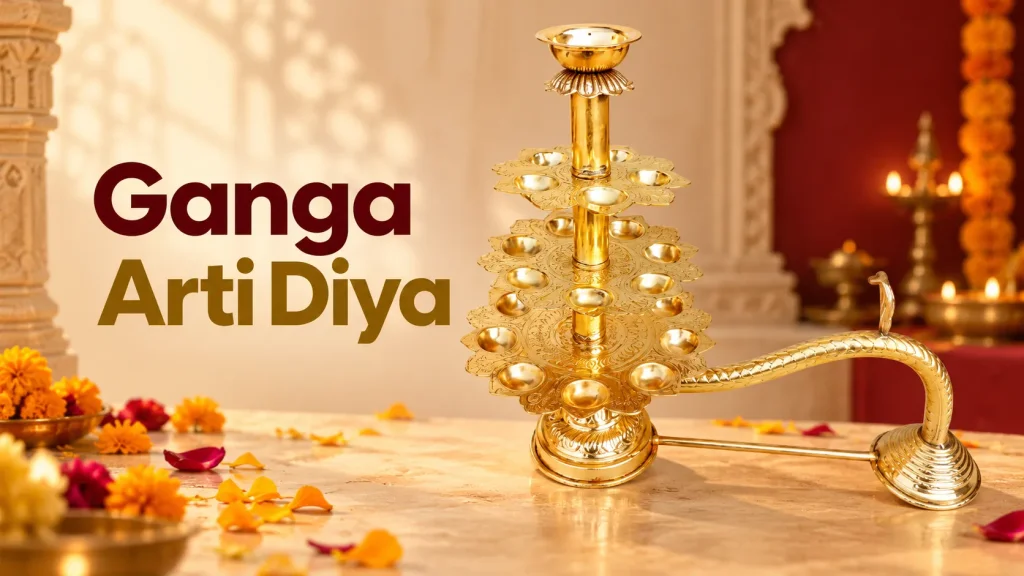
A Ganga Arti Diya is a multi-wick brass lamp designed for a larger, coordinated flame display. It is visually and physically different from a small household diya. The BharatSeLo category listed 5, 9, 21 and 31 bati options, which indicates a progression from relatively manageable ceremonial pieces to larger lamps requiring greater care and preparation.
The visible products were Brass Ganga Arti 5 Bati at ₹1,932, 9 Bati at ₹3,381, 21 Bati at ₹5,554 and 31 Bati at ₹6,814. One verified example, Brass Ganga Arti 5 Bati, was listed at 0.57 kg with dimensions of 12 x 8 x 5.5 inches. Its product code was F721 C. Those numbers give buyers a useful reality check: even the five-wick model needs more storage and handling room than a compact home lamp.
Choose this Diya Deepak category when the intended use is group aarti, temple service, an organised religious event or a spacious home ceremony supervised by adults. A higher wick count does not automatically make a lamp better. More flames mean more fuel, more heat, more smoke potential and a larger safe zone around hands, clothing and decorations.
Before purchase, check who will lift it, how long the aarti normally lasts, whether a heat-safe plate is included or needed, and where the lamp will cool after use. If the user has limited grip strength, a lighter hand aarti diya can be a wiser choice. For cultural context, the official Incredible India page on Haridwar explains the role of large flaming lamps in the evening Ganga Aarti rather than reducing the ritual to a decorative object.
Hand and Arti Diya
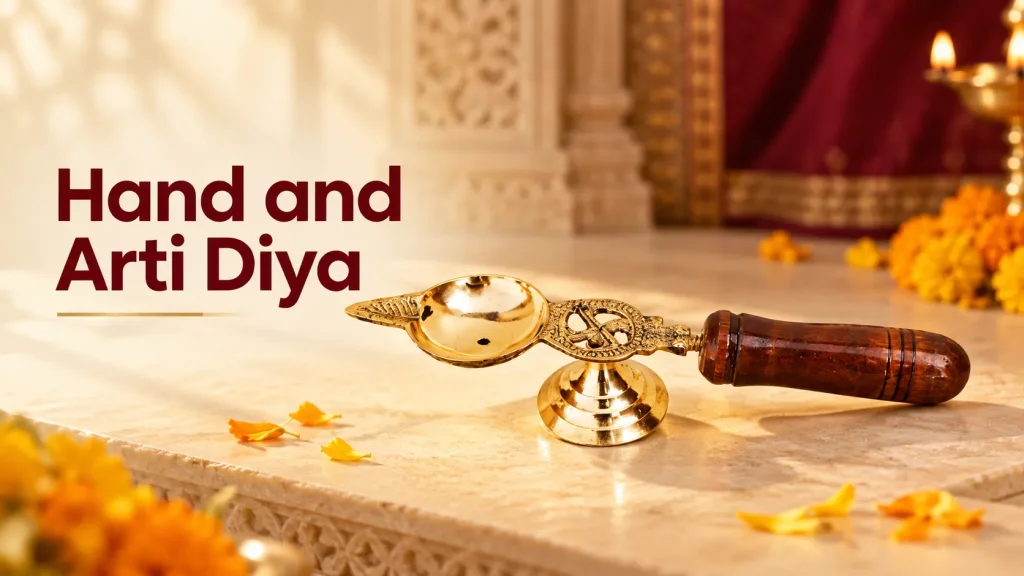
A Hand / Arti Diya is meant to be held and moved in controlled circular motions during aarti. The defining feature is not ornament alone but handling geometry: the grip should provide distance from the flame, the lamp should balance when filled, and the wrist should not need to fight the weight.
Visible BharatSeLo examples included Brass Table Decor Oil Lamp Deepak No. 0 at ₹97, a wooden-handle oil lamp at ₹136 and EK Batti Arti No. 1 at ₹156. The Deepak No. 0 product page listed dimensions of 3 x 1.6 x 0.8 inches and weight of 0.015 kg. Because some products can appear in more than one relevant grouping, read the individual listing rather than relying only on the category name.
A wooden handle can improve insulation and reach, but buyers should still inspect the join between the handle and brass cup. For a one-wick daily ritual, a compact, well-balanced design is usually easier to control. Multi-wick hand lamps create a stronger visual effect but need a firmer grip and a wider movement path.
Keep sleeves, dupattas, hair and flower garlands away from the flame. Do not pass a lit hand aarti diya to a child without close adult supervision, and never leave it on an uneven surface after use. A dedicated metal plate nearby makes filling, lighting and cooling much calmer.
Table Diya
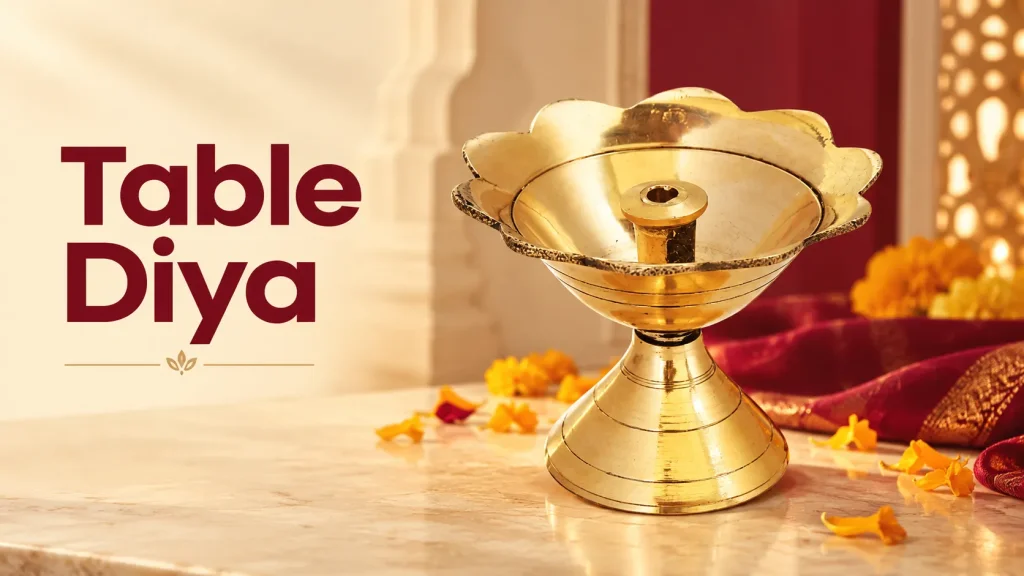
The table diya is the most versatile Diya Deepak for many Indian homes. It can sit inside a home mandir, on a puja thali, near an entrance during festivals or on a heat-resistant tabletop. Its compact size also makes cleaning and storage simpler than wall-mounted or suspended designs.
The visible Table Diya listings started with Deepak Niranjan No. 1 at ₹71, followed by No. 2 and No. 3 at ₹84, a Brass Table Decor Oil Lamp Deepak No. 00 at ₹84, Pyali Deepak No. 00000 and Deepak Niranjan No. 4 at ₹91, and Akhand Deepak No. 4 at ₹104. Deepak Niranjan No. 1 was listed at 0.01 kg and 1.5 x 1.5 x 1.5 inches.
A small table brass diya works well for short daily worship, but size affects more than appearance. A very shallow cup needs closer fuel monitoring, while a narrow footprint may be easier to knock. For longer burning, look for adequate oil capacity, a broad base and a wick rest that keeps the flame positioned away from the rim.
If you are deciding between a separate lamp and an elevated base, BharatSeLo’s diya and diya stand buying guide explains the functional difference and offers useful placement guidance.
The term “akhand” in a product name deserves special caution. A lamp intended for extended burning still requires active supervision, stable placement and regular fuel management. Do not interpret the label as permission to leave an open flame unattended overnight or while the home is empty.
Wall Diya
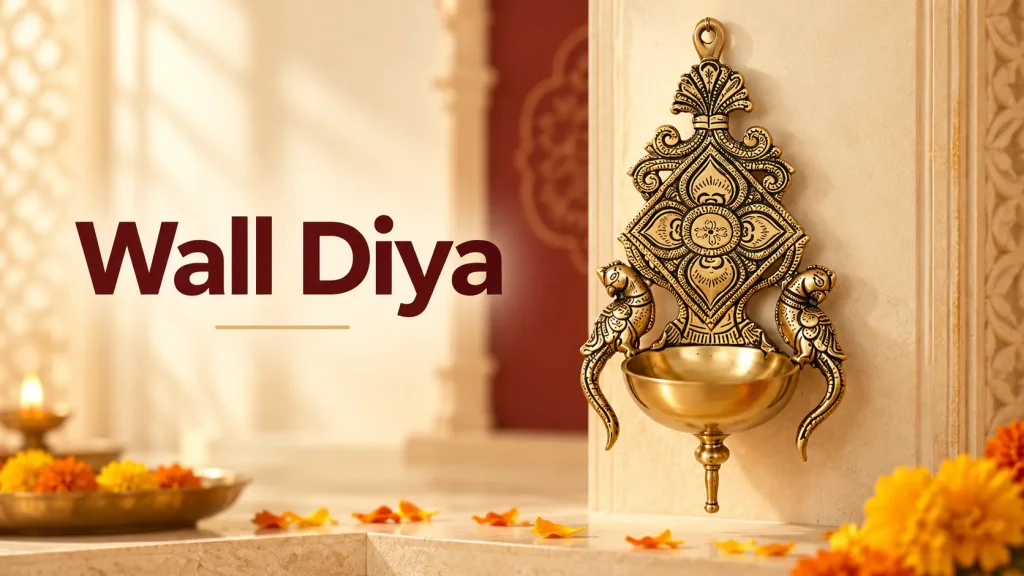
A wall diya combines a lamp with a decorative or devotional backplate. It keeps the lamp off a crowded table and can frame a mandir wall, corridor niche or entrance. The trade-off is installation: once a flame sits against a vertical surface, mounting strength and heat clearance become essential buying criteria.
BharatSeLo’s visible Wall Diya products included a brass wall decor oil lamp at ₹1,081, a parrot design at ₹1,143, evil-eye protector designs at ₹2,696 and ₹2,915, Dancing Ganesha Oil Lamp Deepak With Bell at ₹3,133, and a Lord Ganesh wall lamp at ₹3,875. The first wall decor model was listed at 0.33 kg and 2 x 4 x 6.8 inches.
Check the actual product weight before choosing screws and anchors. The wall material matters too: solid masonry, hollow brick, gypsum board and wood need different hardware. A decorative nail that holds an empty frame may not safely hold a brass deepak containing oil, especially when the fitting warms and is touched during cleaning.
Leave open space above and around the flame. Avoid curtains, paper decorations, wooden shelves, loose wiring and high-traffic passages. If drilling is not possible, do not improvise with a weak adhesive simply because the item looks small. An unlit wall piece can tolerate different mounting choices, but a functioning oil lamp cannot.
For installation planning, read these wall hanging brass diya mounting tips before selecting hardware or placement.
Hanging Diya
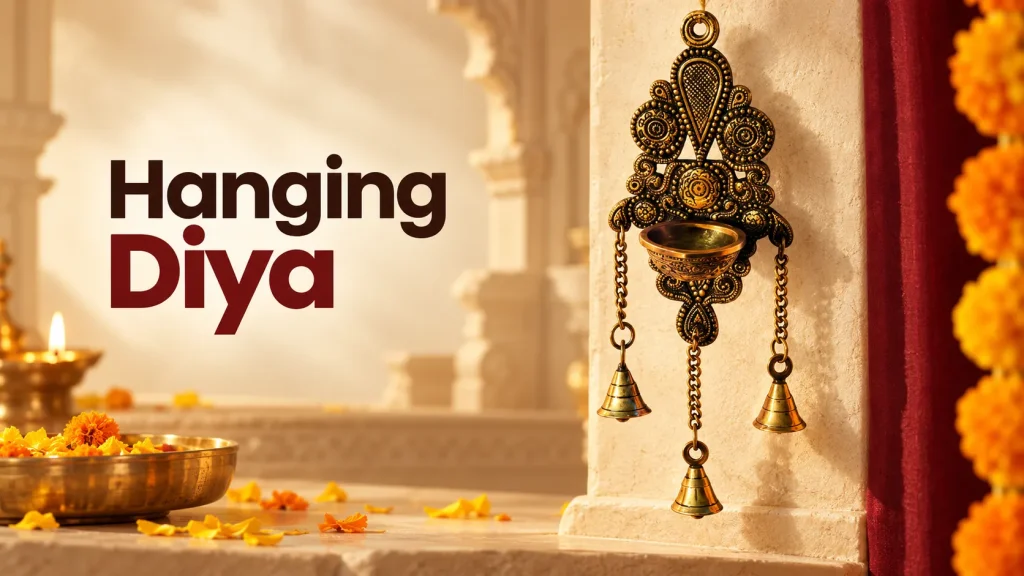
A hanging diya is suspended by a chain from a ceiling hook or a strong bracket. It creates vertical presence without consuming shelf space and is familiar in many temple and South Indian interior settings. Its beauty comes from suspension, but the same feature makes balance the main safety question.
Visible BharatSeLo examples included Brass Showpiece Murga Deepak With Chain Statue at ₹1,259, a Bell With Deepak God Idol at ₹1,523, and several Shank or conch-style antique deepaks from ₹1,748 to ₹2,029. The Murga Deepak example was listed at 0.415 kg and 3 x 3 x 18.5 inches, including its tall suspended form.
Measure from the hook to the bottom of the lamp, not just the bowl. Confirm that the chain links, top ring and ceiling anchor can comfortably carry more than the product’s static weight. Filling and cleaning create additional movement, and a lamp that swings after a light touch can spill oil or shift the wick.
Use a non-flammable drip plate where practical, especially above polished flooring. Keep the lamp away from fans, air-conditioner drafts, doors and places where people stand up beneath it. For homes with active children or pets, an unlit decorative use may be more appropriate than regular burning.
Stand Deepak

A stand deepak raises the oil cup on a pillar or sculptural base. It can suit a floor-level festival arrangement, a large puja room or a spacious table. Compared with a tiny diya, it offers visual height and often a wider base, but buyers must match that height to the room and traffic pattern.
Visible products included Sada Panas Deepak No. 7 at ₹357, No. 8 at ₹409, Dandi Pandeep No. 4 at ₹435, Kerala Fancy No. 1 at ₹448, Sada Panas No. 12 at ₹481, Deepak More Charkar 4 at ₹546, and Kerala Fancy No. 2 or Sada Panas No. 10 at ₹585. The Kerala Fancy No. 3 listing was ₹630.
Sada Panas Deepak No. 7 was listed at 0.1 kg and 3.3 x 3.3 x 6.5 inches. This is a compact stand rather than a large temple pillar, which shows why buyers should use measurements instead of judging from isolated photographs. A close-up product image can make six inches look monumental.
For a home mandir, check shelf height and the clearance above the wick. For floor placement, prefer a broad base and a protected corner where sarees, children and pets will not brush past. If your interest is specifically in Kubera-style lamps and associated traditions, read BharatSeLo’s Kubera diya explainer while remembering that ritual practices vary between households.
Verified BharatSeLo Product Snapshot
The following table combines one representative, individually verified example from each functional category. It is a shopping aid, not a promise that stock or price will remain unchanged. Visit the linked category or product page immediately before purchase to confirm current information.
| Category | Representative product | Price checked | Weight | Dimensions |
| Ganga Arti | Brass Ganga Arti 5 Bati | ₹1,932 | 0.57 kg | 12 x 8 x 5.5 in |
| Hand / Arti | Brass Table Decor Oil Lamp Deepak No. 0 | ₹97 | 0.015 kg | 3 x 1.6 x 0.8 in |
| Table | Deepak Niranjan No. 1 | ₹71 | 0.01 kg | 1.5 x 1.5 x 1.5 in |
| Wall | Brass Wall Hanging Wall Decor Oil Lamp Deepak | ₹1,081 | 0.33 kg | 2 x 4 x 6.8 in |
| Hanging | Brass Showpiece Murga Deepak With Chain Statue | ₹1,259 | 0.415 kg | 3 x 3 x 18.5 in |
| Stand | Sada Panas Deepak No. 7 | ₹357 | 0.1 kg | 3.3 x 3.3 x 6.5 in |
Product names and category spellings are retained close to the website listings, including “Arti” in category names. Dimensions are reported in the order displayed by BharatSeLo, but the site does not label each axis as length, width or height on these examples. If one measurement is critical for a shelf or mounting location, confirm the orientation with customer support before ordering.
How to Choose the Right Diya Deepak
Start With the Actual Ritual or Use
Daily five-minute puja, a family aarti, a large temple ceremony and festive decoration are different jobs. A table diya handles the first job efficiently. A hand lamp supports movement, while a Ganga Arti model serves a more ceremonial setting. Wall, hanging and stand lamps place greater emphasis on installation and visual presence.
Measure the Space Before Browsing
Measure the shelf depth, available height and safe distance from nearby materials. For hanging lamps, measure the complete drop from hook to bowl. For wall designs, mark the position of the flame, not merely the decorative backplate. Keep a metal tray or heat-resistant surface within the plan.
Compare Weight and Stability
Weight can signal substance, but heavier is not automatically better. A hand aarti lamp must be comfortable to move. A wall or hanging lamp requires stronger hardware. A stand design needs a base proportionate to its height. Stability is the useful outcome, not weight for its own sake.
Inspect Material and Finish
The visible collection is presented as brass, but buyers should still read the individual product title, specifications and care instructions. Ask whether detachable parts, handles, chains or bells use other materials. Natural brass darkens with use; this patina is normal and is not by itself proof of poor quality.
Treat Price as a Live Variable
The listed Diya Deepak price can change with stock, size, discounts, shipping or website updates. Compare the final checkout amount, return conditions and delivery estimate. A low price is less helpful if the lamp is too small, unstable or unsuitable for the intended ritual.
Brass Diya Advantages and Limitations
| Advantages | Limitations |
| Reusable and durable with routine care | Requires cleaning because oil residue and tarnish build up |
| Available in compact, handled, mounted and elevated forms | Metal becomes hot near the flame |
| Stable designs can suit repeated household use | Heavier ceremonial models may strain the wrist |
| Can serve devotional and decorative purposes | Wall and hanging styles need correct installation |
| Wide range of prices and sizes | Open flames always require supervision |
Brass is popular for reusable lamps because it can be cleaned and used repeatedly. That does not make every brass design suitable for every home. A buyer with a tiny mandir, rented walls or young children may get more practical value from a simple table Diya Deepak than from an elaborate suspended piece.
How to Use an Oil Diya Safely
- Place the diya on a level, heat-resistant and non-flammable surface.
- Use a cotton wick sized to the cup, with only a controlled portion exposed.
- Add oil or ghee without overfilling, and wipe spills before lighting.
- Light the wick with hair, sleeves and loose clothing secured away from the flame.
- Keep children and pets at a safe distance and supervise the lamp continuously.
- Extinguish the flame safely before moving, refilling or cleaning the diya.
- Allow the brass to cool fully before touching the bowl, chain, handle joint or stand.
- Never leave an open flame burning in an empty home or near curtains and decorations.
Regional and family customs influence the choice of wick direction, fuel and timing. This guide does not replace those traditions, nor does it turn devotional practice into a rigid checklist. The universal part is fire safety: a sacred flame is still a flame.
Cleaning and Care
After the lamp cools, remove the used wick and wipe away loose oil with a soft cloth. Wash only when the product construction permits it, especially if it includes wood, adhesive, bells, chains or mixed finishes. Dry brass promptly so water does not sit in crevices.
For plain uncoated brass, a mild lemon-and-salt paste is commonly used, followed by gentle rubbing, thorough rinsing and immediate drying. Test a small area first. Avoid steel wool and aggressive chemical cleaners because they can scratch the surface or strip a decorative finish.
Soot near the wick lip is easier to remove when it has not accumulated for weeks. Store the Diya Deepak completely dry and wrap delicate chains separately to prevent tangling. Antique-style finishes may be intentionally dark, so polishing them to a bright yellow shine can change the intended appearance.
Who Should Buy Which Type
| Buyer or setting | Most practical choice | Reason |
| Small apartment mandir | Compact table diya | Uses little space and stores easily |
| Daily family aarti | One-wick hand aarti diya | Controlled movement and manageable flame |
| Temple or organised ceremony | Ganga Arti model chosen by wick count | Designed for a larger ceremonial display |
| Decorative wall niche | Wall diya with verified anchors | Keeps the surface clear and creates a focal point |
| High ceiling devotional space | Balanced hanging diya | Adds vertical presence without shelf use |
| Festival floor arrangement | Stable stand deepak | Raises the flame and adds visual height |
| Gift buyer unsure of the recipient’s space | Small table brass diya | Generally easier to place and maintain |
If you are buying as a gift, include the product dimensions and basic care note instead of assuming the recipient has a large puja room. For housewarming, a compact brass deepak is usually easier to accommodate. For bulk or ceremonial purchases, verify stock consistency, packaging and delivery timing directly with the seller.
Frequently Asked Questions
What is the difference between diya and deepak
In common usage, both words refer to an oil lamp. Product catalogues may use “deepak” for a more formal, elevated or decorative design, but there is no universal retail rule. Focus on the lamp’s actual shape, size, wick count and intended placement.
Which Diya Deepak is best for daily puja
A stable, single-wick table brass diya is the simplest option for many homes. Choose a size that fits the mandir shelf and provides safe clearance above the flame. If your household performs moving aarti daily, a light hand aarti diya may be more suitable.
How many wicks should I choose for a Diya Deepak
Choose according to the ritual, the person handling the lamp and the available space. More wicks create more heat and require more fuel and clearance. For household use, fewer wicks are usually easier to manage; large multi-wick Ganga Arti lamps suit supervised ceremonial settings.
Can I use oil and ghee in the same Diya Deepak
Many plain brass lamps can hold either, but follow household practice and check the product design. Clean old residue before switching fuels. Avoid overfilling and make sure the wick sits securely so melted ghee or oil does not spill when the lamp is moved.
Are wall and hanging Diya Deepak designs safe indoors
They can be used only with correct installation, adequate flame clearance, ventilation and continuous supervision. Confirm the weight, use suitable anchors and keep the flame away from curtains, paper, wood and airflow. Decorative unlit use is safer where these conditions cannot be met.
Why does a brass Diya Deepak become dark
Brass naturally tarnishes and flame soot collects around the wick area. Darkening is expected with use and can usually be reduced through gentle cleaning. Check whether the item has an antique or coated finish before polishing, because an abrasive method may damage it.
Are BharatSeLo prices fixed
No online price should be treated as permanent. The figures in this article were checked on 22 October 2026 and reflect visible listings at that time. Confirm the current product page, stock status, delivery charge, discount and return terms before payment.
What should I verify before ordering
Verify dimensions, weight, material description, number of wicks, included parts, mounting needs, processing time, delivery estimate and return policy. For measurements shown without axis labels, contact the seller if shelf height or bracket depth is critical.
Final Buying Advice
The best Diya Deepak is not necessarily the largest, most ornate or most expensive. It is the lamp that fits the ritual, the handler and the physical space. A small table diya can be the right daily companion, while a multi-wick Ganga Arti lamp belongs in a planned ceremonial environment.
Use BharatSeLo’s six subcategories to narrow the format first, then compare individual product measurements and live prices. Prioritise stability, safe flame clearance and ease of cleaning. When tradition influences the final choice, follow the practice of your family or religious guide and treat online advice as practical support rather than a universal rule.
Diya Deepak Final Purchase Checklist
Use this final Diya Deepak checklist on the product page and again before checkout. It keeps the decision focused on practical fit rather than photographs alone.
- Confirm that the Diya Deepak category matches the intended use: stationary, handheld, wall-mounted, hanging or elevated.
- Compare the Diya Deepak dimensions with the measured shelf, wall space or ceiling drop.
- Check whether the Diya Deepak weight is comfortable for the user or suitable for the chosen mounting hardware.
- Count the wicks and decide whether the Diya Deepak flame output is appropriate for the room and ritual.
- Inspect the Diya Deepak base, handle, chain or backplate for the stability the placement requires.
- Verify whether every Diya Deepak component is brass or whether wood, bells, chains or other materials are included.
- Plan a heat-resistant plate or drip surface below the Diya Deepak before its first use.
- Keep enough open clearance above and around the Diya Deepak flame.
- Read the latest Diya Deepak price, stock status, shipping charge and delivery estimate at checkout.
- Review the Diya Deepak return conditions before removing tags, packaging or protective material.
- Ask the seller to clarify any Diya Deepak measurement whose axis or orientation is not labelled.
- Choose a simpler Diya Deepak when the ornate option creates avoidable handling or installation risk.
A careful Diya Deepak purchase should feel straightforward: the lamp fits, the flame has safe clearance, and the person using it can handle and clean it comfortably. If any of those points remain uncertain, confirm the specification before payment.